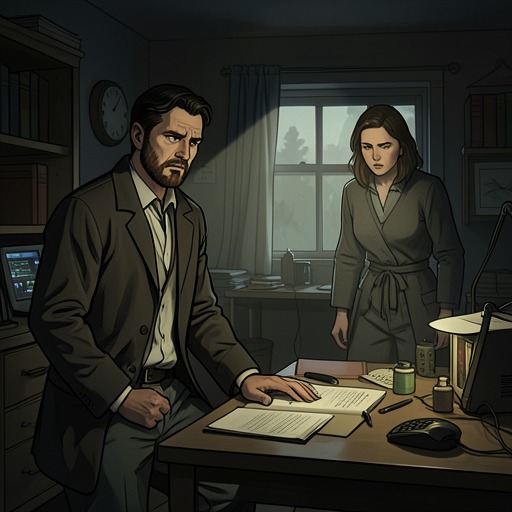
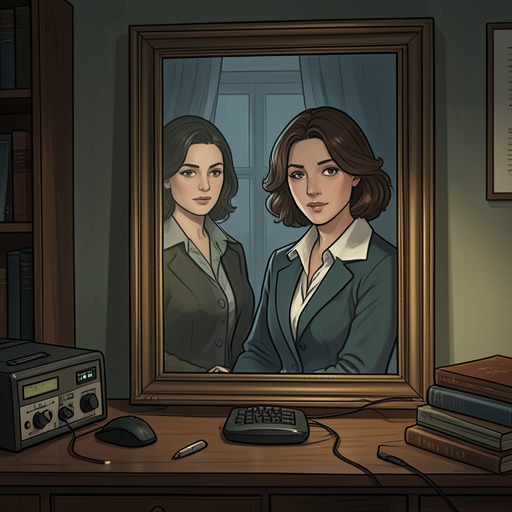
Amy Hide and her parents
Other PeopleAmy Hide’s relationship with her parents emerges through absence, family testimony, and photographs rather than through a direct encounter. When Mary Lamb visits to ask about Amy, she learns that Amy’s disappearance has left a lasting wound: Marge says that Amy caused her parents pain and that her mother died of a broken heart over her. Yet the house and its pictures preserve a less simple record than Marge’s bitter account alone. Amy remains present as a daughter remembered, resented, and still capable of unsettling those who speak of her.
Family History and Estrangement
The available account presents Amy’s family bond as deeply damaged, although it does not explain the history of that damage in detail. Mary has read that Amy Hide, aged twenty-six, has gone missing and that the police believe she may have been murdered, while remaining uncertain. When Mary gives her name and says she has come to ask about Amy, the response is immediate: Marge and George react with visible discomfort, and Marge declares that Amy is best left unmentioned. Her finality suggests that the family’s silence is not indifference but a boundary formed around painful memories.
Marge soon makes the cost of the relationship more explicit. She says that Amy caused her poor parents pain and swears that Amy’s mother died of a broken heart over her. This is Marge’s account, delivered with strong emotion, not an independently confirmed explanation of the mother’s death. The distinction matters: Mary receives the family history through someone who is angry and grieving, and the strength of that testimony does not make it a complete account of Amy’s life or of her parents’ relationship with her.
The family’s pain is also complicated by the uncertainty surrounding Amy herself. She has been missing for eight or nine years, according to Marge, and the police suspect murder without being certain. The parents’ anguish therefore belongs to a history of prolonged absence as well as remembered conflict. Amy is not simply a daughter who has left the household; she is a missing person whose fate remains unresolved in the information Mary has encountered.
The Family Remembered in the House
Marge takes Mary into a room that has changed since Amy was last there. It is now used for visitors, and Amy has not returned for eight or nine years, but Marge says that some of it remains the same. The room’s altered use and lingering remnants give the family history a physical setting: the past has neither been preserved intact nor completely cleared away. For Mary, who has come seeking a connection to Amy, the room offers no simple confirmation of belonging.
Among the photographs on the mantelpiece, one larger study shows a man, a woman, and a young girl standing in a field beneath a threatening-looking sky. The man is tall and angular, his face partly turned away; the woman reaches towards his shoulder, and the girl stands between them. Marge identifies a different photograph as Baby, the youngest child, whose given name is Lucinda. The family portrait therefore places Amy within a household that also includes a younger daughter, while its arrangement makes the adults’ closeness and the child’s position visible without explaining what their relationships were like in private.
Other pictures on the mantelpiece show scattered groups of people, a dog in sunlight, and George and Marge posed cheek to cheek. Their presence makes the shelf a record of shared domestic life, but it does not resolve the conflict surrounding Amy. The image of a family gathered in a field sits beside Marge’s present-day insistence that Amy brought pain to her parents. Photographs preserve a visible grouping; Marge’s words supply the estrangement that the image itself cannot show.
Marge’s Testimony and Mary’s Response
Mary’s visit brings the family story into the present. She introduces herself as Mary Lamb and says she knew Amy a long time ago, before what happened to her. She calls Amy’s fate sad, but Marge rejects that description, saying that nothing about Amy was sad. The disagreement exposes two different positions: Mary approaches Amy through personal attachment and loss, while Marge speaks from the parents’ suffering and the harm she believes Amy caused them.
Marge’s anger does not remain emotionally controlled. After describing the mother’s death, she breaks off, sits down, and cries. George calls her by name, and Marge says that Amy can still affect them even now. Mary begins crying too, though she cannot explain the reaction as a recovered memory or a settled understanding of her connection to Amy. The encounter shows Amy’s continuing power over those gathered in the house: even in her absence, speaking her name draws grief into the room and passes it from one person to another.
Marge’s account is not wholly consistent in tone. She first shuts down discussion of Amy, then explains the family’s suffering, comforts Mary, and recognizes that Amy can still affect everyone. She also clarifies that she is not wearing black for Amy. That statement leaves the meaning of her mourning attire unresolved, but it resists an easy reading of the black dress as public mourning for the missing woman. Her grief and anger are real in the encounter, yet they do not produce a simple declaration of love or reconciliation.
Significance of the Relationship
The parents’ relationship with Amy is presented as a bond shaped by estrangement and unresolved loss, with its history filtered through the people and objects Mary encounters. Marge’s account establishes the severity of the parents’ distress, while the photograph locates Amy within a family scene that words have since made painful. Neither source cancels the other: the picture cannot prove familial harmony, and Marge’s accusation cannot fully explain Amy.
The family’s uncertainty also mirrors the uncertainty of Amy’s fate. She has been absent for years, is believed possibly murdered, and remains forcefully present in the emotions of those who remember her. For Mary, the visit connects the name she has pursued to a household where that name is unwelcome and grief-stricken. The relationship matters not because it supplies a complete explanation of Amy’s past, but because it reveals the cost of her absence and the limits of what can be known from another family’s testimony.